
2026 Marketing Strategy: Why the Funnel Stopped Working (And What Replaces It)
Key Takeaways
- Six out of ten Google searches end without a click to any website. Organic traffic no longer measures visibility.
- B2B buyers start their research in ChatGPT or Perplexity, not Google. Most arrive with a vendor already in mind.
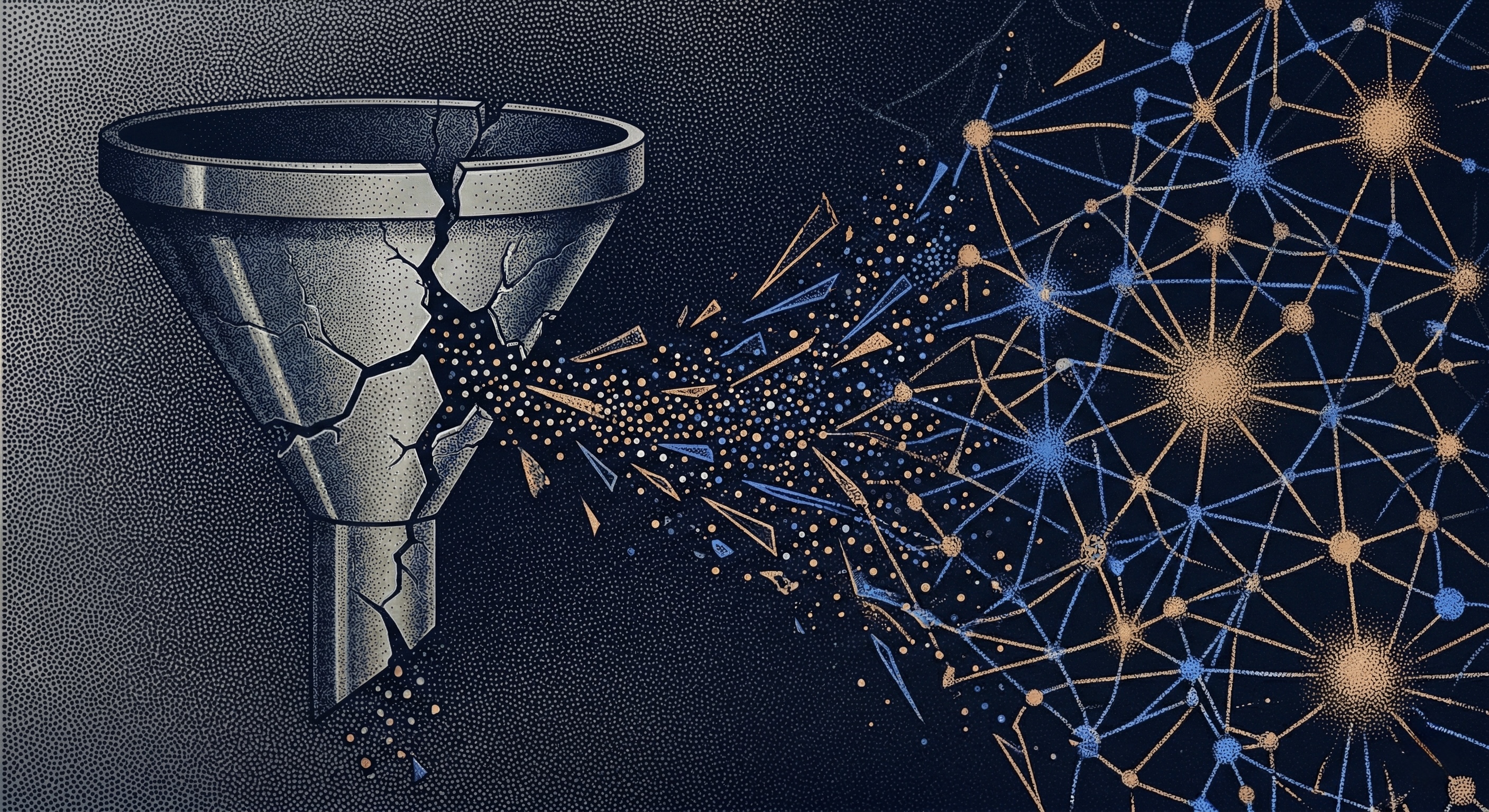
- The TOFU/MOFU/BOFU funnel is breaking down: traditional channels convert less, gated content alienates buyers, and lead scoring fails to predict sales.
- Most buying influence happens in channels your dashboards can't see: communities, podcasts, word of mouth, AI conversations.
- The replacement model: build familiarity (demand generation) instead of capturing leads (lead generation). Track your semantic footprint across the digital ecosystem.
The Great Decoupling
Digital marketing has a paradox. Search volumes keep climbing. Marketing budgets too. But clicks to websites are collapsing, and acquisition costs keep rising. The model is broken.
HubSpot, the company that invented inbound marketing, shows this best. Between late 2024 and early 2025, HubSpot lost about 80% of its blog organic traffic. Google's AI Overviews answered user questions on the results page, killing the click. Yet HubSpot's stock price held steady. Years of brand familiarity with their audience protected the business even as traffic metrics cratered.
One question matters now: do people think of you when the need arises? Traffic stopped being the answer.
This isn't cyclical. Three forces are converging to make the marketing playbook that dominated since 2015 obsolete.
1. Search Has Shattered Into Fragments
People don't "search Google" the way they used to. They ask ChatGPT. They browse TikTok. They validate on Reddit. Ten different channels, most of them invisible to your analytics tools.
AI as a search channel
ChatGPT, Perplexity, Gemini, and Claude have become major entry points for information. They haven't replaced Google (which still processes 14 billion queries per day), but they've fragmented the search habit.
B2B buyers trust AI-generated summaries as much as vendor-produced content, according to Forrester. The corporate website has become a late-stage validation stop, not a discovery channel. By the time a buyer lands on your site, they've already formed an opinion.
Social search
TikTok, Reddit, and YouTube work as full search engines, most of all for people under 35. The trend extends well beyond Gen Z.
Reddit has become a cross-market validation hub. Buyers, including B2B decision-makers, append "reddit" to their Google queries looking for unfiltered experience reports. Reddit is also the most-cited source in Google's AI Overviews (Profound/Trisolute analysis, 10 million citations). Google's own AI trusts community discussions over product pages when it picks sources.
Podcasts and newsletters are booming. US podcast ad revenue crossed $3 billion in 2025 (IAB). These channels thrive because they offer owned audiences, the asset you need when discovery channels keep splintering.
The B2B buying journey went dark
Most of the B2B buying journey happens without any direct vendor contact. Gartner puts the number at 80% autonomous: private communities, Slack conversations, podcasts, word of mouth.
The most telling data point comes from Forrester: close to half of first-time B2B buyers enter the process with a vendor already in mind. B2B buying is a confirmation process, not a selection process. The vendor contacted first wins about 84% of the time. If you're not on the shortlist on day one, you're not getting on it.
2. The Funnel Is in Systemic Crisis
"SEO, gated content, email nurturing, MQL scoring, demo." That playbook powered a generation of marketing teams. It has stopped working.
Traditional channels are losing effectiveness
Google displays an AI-generated answer (AI Overview) at the top of the results page, and click-through rates collapse. Users get their answer without clicking. A Seer Interactive study across 25 million impressions measured a 61% drop in organic CTR for queries with AI Overviews. Even without AI Overviews, organic CTR fell 41% year over year.
Paid search tells the same story. Google Ads cost-per-click has risen for five consecutive years. ROAS declined in 13 of 14 industries tracked by Triple Whale across 18,000 brands. Marketers spend more and get less.
Gated content has hit the wall
Fewer than half of B2B buyers say they'd give their email to access a whitepaper or ebook (Scribewise 2024). ChatGPT delivers the same information for free in 30 seconds. A ten-field form for a PDF feels like a bad trade.
Mark Schaefer documented a clear case: a gated piece generated 295 sign-ups in five months. The same content shared in the open on LinkedIn generated 1,100 opt-ins in 48 hours. The Juice analyzed 300,000 pieces of content and found ungated content generates 26% more engagement. The best-performing brands gate less than 3% of their content.
Lead scoring no longer predicts sales
Forrester reports that 98% of MQLs (Marketing Qualified Leads) never convert to a closed deal. Traditional lead scoring, giving points because someone opened an email or downloaded a PDF, creates false positives that overwhelm sales reps without reflecting real purchase intent. A controlled experiment reported by Ortto on 800 leads found no statistical difference between "sales-ready" scored leads and randomly selected ones.
The lead generation software market is worth $7.4 billion in 2025. Stacking more tools doesn't solve the qualification problem.
| Model | Logic | KPIs | 2026 Relevance |
|---|---|---|---|
| Linear Funnel (Lead Gen) | Email capture via gated content, sequential nurturing | MQL volume, cost per lead | Declining. High attrition, high friction |
| Demand Generation | Ungated content, influence through untraceable channels | Pipeline generated, self-reported attribution | Dominant. Aligned with how autonomous buyers behave |
| Flywheel | Customer at the center. Referrals fuel acquisition | Retention, NPS, referral-driven acquisition | Needed to reduce CAC as ad saturation grows |
3. The New Model: Familiarity Before Capture
Marketing in 2026 doesn't capture intent. It creates intent. The question shifts from "how many leads?" to "how many people think of us when the need arises?"
Surround Sound Strategy
Your prospect searches for a solution. They shouldn't find your website alone. They should find you everywhere: third-party articles, comparison lists, reviews, Reddit threads, podcasts, AI answers.
The psychology behind it is well documented: the mere-exposure effect. Repeated appearance across varied, independent contexts builds perceived legitimacy. HubSpot grew its SERP coverage by 40% in seven months using this approach.
In 2026, surround sound extends to AI responses. LLMs cite brands they "see" associated with a topic across multiple web sources. "Entity strength," the frequency with which a brand co-occurs with relevant topics across diverse sources, determines whether ChatGPT and Perplexity include you in their answers. Wynter's 2025 data shows 84% of B2B buyers use AI for vendor discovery, and 68% start in AI tools before touching Google.
Zero-click content
Amanda Natividad (VP Marketing, SparkToro) popularized the concept: deliver the full value on the platform, without requiring a click to your site.
A LinkedIn post that gives the complete insight beats a teaser with a link. Posts without links get up to 8x more reach. 97% of the most-viewed Facebook posts contain no external link (Meta Transparency Report 2025).
Counterintuitive. But when 60% of searches generate no click, the content that asks for nothing builds the most familiarity. Recommended ratio: four or five high-value zero-click posts for each post containing a link.
GEO (Generative Engine Optimization)
A new discipline: optimizing to be cited by AI models (ChatGPT, Perplexity, Gemini), not ranked in Google's blue links.
The foundational paper (Aggarwal et al., ACM SIGKDD 2024, researchers from Princeton and Georgia Tech) shows GEO techniques can increase a site's visibility in generative engine responses by 40%. Brands cited in Google's AI Overviews see +35% organic CTR and +91% paid CTR compared to brands not cited (Seer Interactive).
The core techniques: Schema.org structured data (present in 81% of pages cited by AI engines), factual content with explicit source citations, LLMs.txt files (the robots.txt equivalent for AI crawlers).
| Traditional SEO | GEO | |
|---|---|---|
| Goal | Drive clicks through blue links | Get cited and recommended in AI responses |
| KPIs | Organic traffic, SERP position, CTR | AI share of voice, AI referral traffic |
| Preferred content | Long articles, keyword density | Original data, E-E-A-T expertise, TL;DR summaries, structured data |
4. Semantic Footprint: The Metric That Matters Now
Clicks are evaporating. Influence is invisible. The question isn't "what's my traffic?" It's: what's my semantic footprint?
Your semantic footprint is the set of associations the digital ecosystem (search engines, LLMs, communities, media) makes between your brand and the topics your customers care about.
A strong semantic footprint: ChatGPT names you when a prospect asks "best tool for [your category]." You appear in your industry's comparison lists. Your experts get mentioned in the right podcasts. Third-party content about your topic references your brand.
A weak semantic footprint: you're invisible, even with a great product and an optimized site.
Why this is the right steering metric
Classic metrics have stopped reflecting reality:
- Traffic doesn't measure influence. Over 60% of searches generate no click.
- MQLs don't predict revenue. 98% never convert.
- Software attribution sees a sliver of the real journey. Refine Labs' "Attribution Mirage" study found a 90% gap between what software attributes and what customers report. Podcasts accounted for 53% of revenue in self-reported attribution, 0% in the attribution software.
Your semantic footprint captures what these metrics miss: does your brand exist in your prospects' mental universe?
How to monitor your semantic footprint
- AI citations: check whether your brand appears in ChatGPT, Perplexity, and Gemini responses for your market's key queries
- Semantic associations: which topics does your market treat you as a reference for? Where are the gaps, the critical market topics where you show up nowhere?
- Coherence: do your content, structured data, third-party mentions, and community presence tell the same story?
- Self-reported attribution: ask your customers "how did you hear about us?", the most reliable signal for where demand originates
This shift is why we built Nodiris. We help companies make this transition: from marketing centered on traffic and leads to marketing centered on semantic footprint and familiarity. In practice, that means auditing your current digital presence, structuring a content strategy for the channels that matter now (AI, communities, social), and deploying tools like knowledge graphs to make your footprint measurable and actionable. We covered the role of knowledge graphs in this shift in a dedicated article.
Conclusion
Digital marketing isn't ending. A specific model of digital marketing is ending: the one that promised total measurability and mechanical acquisition through the funnel.
Marketing in 2026 looks more like marketing has always looked: building a brand that comes to mind at the right moment. The difference is that "the right moment" now plays out in AI conversations, private communities, and channels your dashboards don't track.
The companies that win won't be the ones generating the most leads. They'll be the ones with the strongest semantic footprint in their customers' ecosystem.
FAQ
Is SEO dead?
No. But SEO alone won't get you there. SEO still drives Google visibility, and it feeds AI responses indirectly. LLMs pull from well-ranked content when they generate answers. The task is to embed SEO within a broader strategy that includes community presence, social platforms, and AI engines.
Should you stop gating content entirely?
Not entirely. Gating still makes sense for proprietary research, exclusive benchmarks, or premium events, content whose value justifies the exchange. Educational content, though, needs to be free. Free content builds the familiarity and trust that gated forms erode.
Where do you start adapting your marketing strategy?
With an honest diagnostic. Look at where your customers come from, not what your attribution tool reports, what your customers say. Add a "how did you hear about us?" field to your forms. Identify the channels where your prospects research (communities, podcasts, AI). Then show up in those channels with content that gives value and asks for nothing.
How do you measure demand generation effectiveness?
You don't measure demand generation in leads. You measure it in familiarity signals: branded search volume trends, organic community mentions, AI citation frequency, conversion rates for prospects who arrive already knowing your offer. And the most direct signal: self-reported attribution, asking your customers how they found you.
What do knowledge graphs have to do with marketing?
Marketing is a connections problem: between topics, audiences, content, channels. Knowledge graphs structure those connections in a way you can act on. They let you map your semantic footprint, find the gaps, and verify that all the signals you send to market (content, structured data, third-party mentions) tell a coherent story. We go deeper in this article.
A content strategy built for the AI era
Initial diagnostic · First results in weeks